Field note · 18 November 2026
Cross-belt sorters: throughput is an induction problem
A cross-belt sorter can discharge at extraordinary rates, but the line only runs at the speed its induction can feed it. The cells are not the constraint; the gap between parcels on the infeed is.
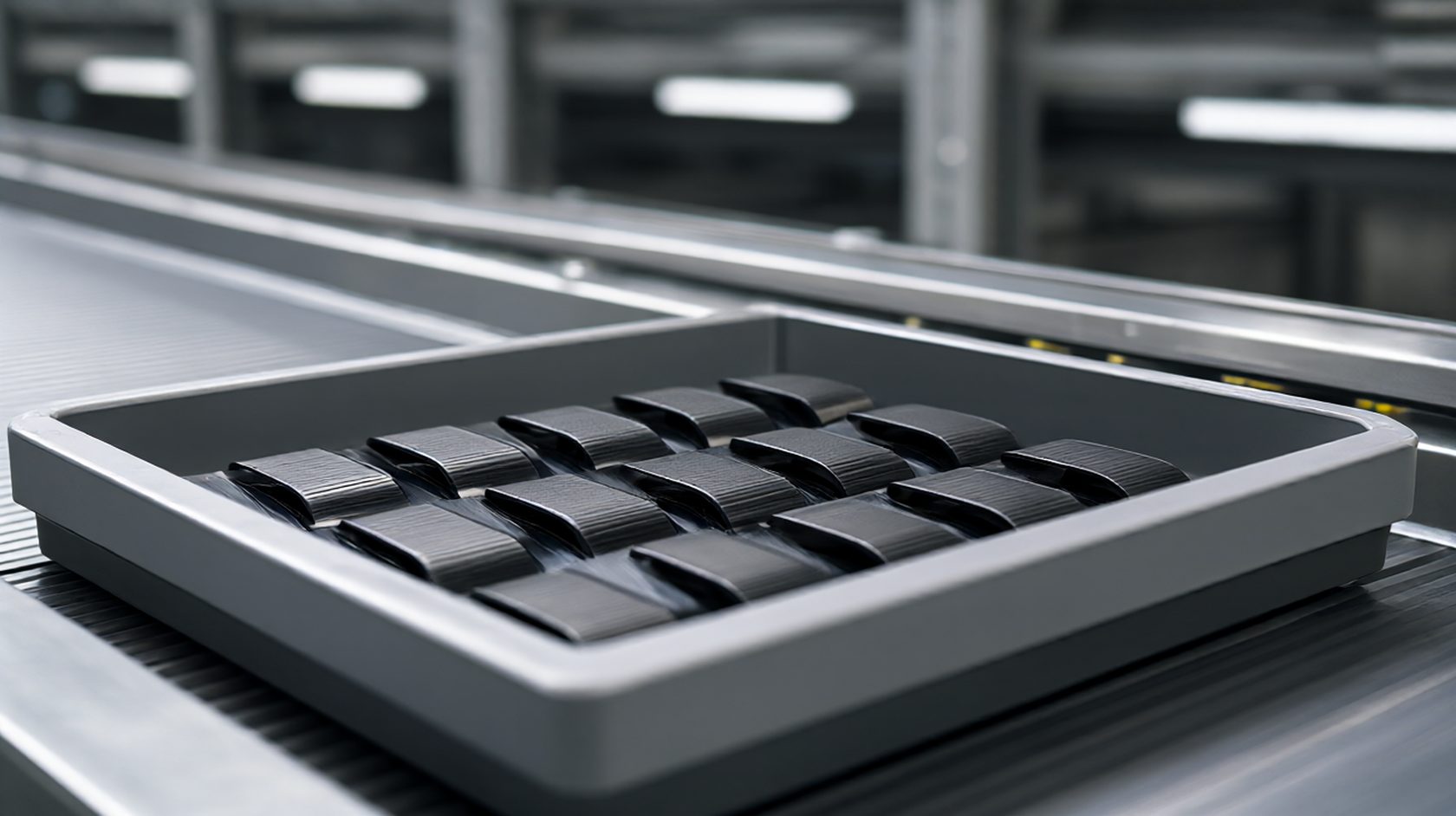
01The cell, the belt, and the two millimetres that matter
A cross-belt carrier is a tray with a short belt mounted across it. The belt is 400 to 700 mm long, it runs on two pulleys inside the carrier, and it discharges the parcel sideways when the carrier reaches the right chute.
The belt tracking is the maintenance item that decides everything. A belt that has drifted two millimetres to one side will still carry a parcel, and it will still discharge, until the day it rubs a sidewall and the carrier starts throwing parcels slightly late.
The carrier pitch is fixed by the tray and the chain, typically 500 to 800 mm. That pitch is the theoretical minimum spacing between parcels, and it is not the spacing the line actually achieves.
02Where the real constraint sits
The sorter's theoretical rate is pitch divided by speed: a 700 mm pitch at 2.0 m/s gives about 10,000 parcels an hour per line. Almost no real installation reaches that number, because the induction cannot place a parcel in every cell.
Induction is the art of putting a parcel onto a moving carrier at the moment the carrier arrives, with the parcel centred and square. Every induction station has a cycle time, and that cycle time sets the practical rate.
A single induction station feeding a cross-belt line is usually good for 2,500 to 3,500 parcels per hour with a competent operator and a well-presented parcel stream. To reach 8,000 the line needs four or five inductions, each with its own buffer and its own singulation.
03Induction buffers and the cost of starving a cell
A starved cell is not a small loss. If one cell in ten goes empty, the line loses ten per cent of its capacity, and the carriers behind the empty cell do not make up the difference.
The buffer in front of each induction holds the parcels that are waiting, and its size is set by the variance in the upstream flow rather than by the mean. A buffer sized to the mean will starve on every busy half hour.
The control that decides which induction fires next is worth as much as the hardware. A line that alternates inductions on a fixed timer will starve one station while another has a queue; a line that assigns the next free cell to the station with the most urgent parcel will not.
04Discharge accuracy and the chute that forgives it
A cross-belt discharge is a throw. The belt accelerates the parcel sideways, and the parcel lands in a chute that has to accept a range of entry angles, speeds and rotations.
Chute design therefore absorbs the sorter's tolerance. A chute with a generous throat and a soft entry will take a parcel arriving at 15 degrees off square; a tight chute will reject it and send the parcel round again.
The recirculation rate is the honest measure of how well the sorter and the chutes agree. Below two per cent is a well-integrated line; above five per cent the line is losing capacity to its own discharges, and the fix is usually in the chute, not the belt.
05Cell allocation and the destination map
Every chute has a destination, and every destination has a demand pattern. The map that assigns chutes to destinations is a throughput decision, because a chute that fills early closes and pushes its parcels into a second pass.
The usual mistake is to give the busiest destination one chute. A destination that receives a thousand parcels an hour needs three or four chutes, or the operators cannot clear them fast enough.
The map should be reviewed against the order profile every quarter. A destination that was marginal at launch can become the constraint in a peak season, and the chute that served it is still allocated one slot.
The control system should report chute closure events by destination. That report is the evidence for re-mapping, and it is usually the only evidence anyone collects.
06Power, heat and the carrier fleet
A cross-belt carrier carries its own motor and its own belt, and the fleet's power draw is a real design constraint. A line of two thousand carriers is a line with two thousand small motors, and the supply has to be sized for all of them at once.
Heat is the second constraint. Motors that run continuously in a closed carrier run warm, and a carrier that overheats will fault at the busiest hour of the day rather than at a convenient one.
The maintenance regime follows from this: carrier faults are usually power or heat before they are mechanical, and a fleet that reports faults by carrier number is a fleet that can be diagnosed.
The spare carrier count is set by the fault rate, not by the fleet size. A line with a two per cent annual fault rate and four hundred carriers needs eight spares, and the number should be in the contract.
07Replacing a belt on a live line
A cross-belt replacement is a scheduled job, not a breakdown job. The carrier has to be brought to a maintenance position, the belt has to be tracked, and the carrier has to be re-introduced without disturbing the pitch.
The job takes twenty to forty minutes per carrier once the team is practised, and the practice comes from doing it on a planned basis rather than on a fault.
The belts that fail earliest are the ones on carriers that discharge into the busiest chutes, because they run most often. A replacement plan that ignores duty is a plan that replaces the wrong belts.
The belt's tracking after replacement is the acceptance criterion. A belt that is centred but not tensioned will walk within a week, and the carrier will be back in the maintenance queue.
08The carrier that keeps arriving early
A carrier that reaches the discharge point before the control expects it will throw the parcel into the chute wall, and the fault looks like a chute problem rather than a carrier problem.
The cause is usually chain stretch or a worn sprocket, and it appears as a gradual shift in the carrier's position against the encoder count. The drift is small and the effect is large.
The check is a marked carrier and a stopwatch: time one lap, then time the lap after a shift, and compare. A lap that is two per cent short is a chain that has stretched two per cent over its length.
Chain tensioning is a scheduled job, and skipping it is how a line acquires a reputation for throwing parcels into chute four.
09Why the induction operator is part of the machine
The induction is a physical skill. The operator presents the parcel, reads its label, decides the orientation and releases it into a moving gap, and the gap is different every time.
An experienced operator places a parcel every second without apparent effort; a new one takes two seconds and puts half of them slightly off centre. That difference is a third of the line's capacity, and it is invisible in the datasheet.
Training the induction is therefore a throughput investment. A day of practice on a stopped line, with a coach watching the release point, is worth more than a new induction station.
The other half of the investment is the presentation. A buffer that delivers parcels label-up and square lets a competent operator work at full speed; a jumbled buffer makes every parcel a decision.
10The five-minute handover between shifts
The shift handover is where a line loses its rhythm. A carrier fault that is not passed on becomes a fault the next shift discovers at the busiest hour.
The handover should carry four items: the fault log, the chute that is closed, the induction that is staffed short, and the parcel mix that has changed. Four lines on a board, read aloud.
A line that hands over verbally loses the numbers. A line that hands over a board keeps them, and the numbers become the first thing the incoming supervisor looks at.
The carrier pitch that makes four inductions viable is the one on the cross-belt sorter, and its discharge length is what the chute throat has to accept.
What to check
- Pitch and belt length against the largest parcel in the mix
- Number of inductions matched to the target rate, not to the sorter's peak
- Buffer size set from the flow variance over the busiest hour
- Recirculation rate measured during commissioning, per chute