Field note · 18 November 2026
Commissioning a sorter: the tests that decide acceptance
A sorter is accepted on numbers, and most of those numbers are measured in a week when the line is new and the operators are learning. The test plan is what makes that week count.
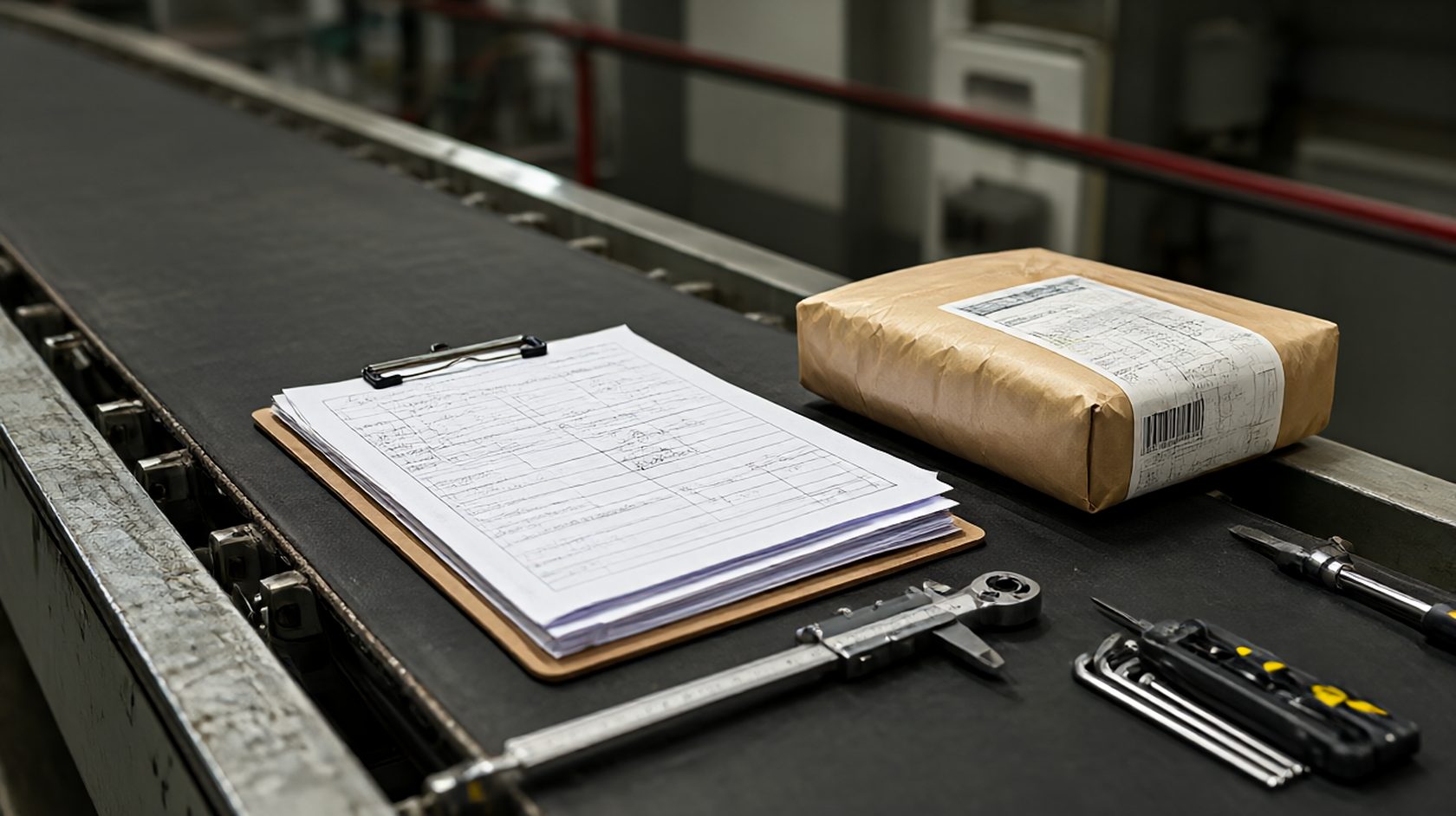
01What acceptance actually means
Acceptance is not the day the line runs. It is the day the line proves it can run at the contracted rate, on the contracted mix, with the contracted recirculation limit, for long enough to be believed.
That proof takes a test plan agreed before installation: what is measured, on which parcels, for how long, and what happens when a number misses.
The plan is also the protection for the integrator. A line measured against an undefined mix will always fail, and both sides will spend the retention period arguing about definitions.
02The four-hour run
The core test is a continuous run of at least four hours at the design rate, on a mix that includes the difficult parcels rather than the average ones.
Four hours matters because the failures that matter are thermal and mechanical: belts that track badly when warm, motors that lose torque, and operators whose error rate climbs after two hours.
The run should be instrumented rather than observed. Parcels per hour, recirculation per chute, stops per hour and mean time to clear a jam are the four numbers that describe the line.
03Jam recovery and the clock that keeps running
Every sorter jams. The question is how long it takes to clear. A line that stops for ten minutes per jam is a line that loses an hour a shift at six jams.
Jam recovery is a training problem as much as an engineering one. The operators who can clear a diverter jam without calling maintenance are the difference between a line that runs at 90 per cent availability and one that runs at 70.
The test should include a deliberate jam, cleared by the shift team, timed. It is uncomfortable to watch and it is the most useful hour of the commissioning week.
04The data acceptance
The control system's data has to be accepted as well: the scan rate, the no-read rate, the chute assignment accuracy and the reconciliation between what the sorter says it sorted and what the warehouse management system received.
A one per cent reconciliation gap is invisible in a good week and expensive in a bad one, because every order in the gap has to be found by a person.
The data test is also the moment to confirm that the line's exception reports exist and are readable by the shift supervisor rather than only by the integrator.
05Handover documents that survive the integrator
The tender documents are the ones the operation will need in year three: as-built drawings, the parcel mix assumptions, the divert settings, the maintenance schedule and the spare parts list with part numbers.
The assumptions matter most. A line is designed around a mix, and the mix will drift. Six months later the operation needs to know which assumption changed before it can explain why the rate fell.
The spare parts list should be short and specific. A list that names every component is a list that gets ignored; a list that names the ten items that stop the line is a list that gets stocked.
06The punch list and the items that never get fixed
Every commissioning produces a punch list, and every punch list has items that survive into operation. The ones that survive are usually the ones that do not stop the line, which is exactly why they matter later.
A guard that is missing, a sensor that is misaligned, a label that is unreadable: each is small, and each becomes a permanent workaround that the operation inherits.
The discipline is to close the list before the retention payment, not before the next project. A list closed on the last day is a list closed by exhaustion.
The list should be owned by one person on each side, with dates. A list with no owner is a list that becomes a complaint.
07Spares, training and the team that inherits the line
The team that commissions a line is not the team that runs it. The knowledge transfer between them is the most undervalued part of the project.
Training should cover the four things that stop the line: a jam at the divert, a carrier fault, a sensor that has drifted and a control that has lost its position reference. Each is a fifteen-minute procedure.
The spares list should be arranged by those four, not alphabetically by part number. An operator who can find the divert belt in thirty seconds is an operator who clears the jam in ten minutes.
The training record should be held by the operation, not the integrator. A record the integrator holds is a record that leaves with them.
08The thirty, sixty and ninety day reviews
A sorter's performance at thirty days is not its performance at ninety. The reviews are the mechanism that catches the drift before it becomes the baseline.
At thirty days the questions are mechanical: tracking, belt condition, fault log, jam causes. At sixty they are operational: rate against the design, recirculation by chute, operator error rate.
At ninety the questions are commercial: does the line meet the contract, and if not, what is the plan? A review at ninety days is early enough to fix and late enough to know.
The reviews should be scheduled in the contract. A review that is proposed after a problem is a negotiation; a review that is scheduled is a measurement.
09The acceptance meeting that settles the contract
The acceptance meeting should be short, because the numbers were agreed before the test. A meeting that argues about definitions is a meeting that started too late.
The agenda is four lines: the rate achieved, the mix tested, the recirculation rate, and the open punch items with owners and dates. Everything else is a conversation for the review at ninety days.
The retention release should be tied to the punch list, not to the signature. A signature that releases retention before the guards are fitted is a signature that buys a permanent workaround.
The meeting record should be the same document the operation uses in year three when it asks why the line runs at eight thousand instead of nine. The mix tested at acceptance is the answer.
10The first month is the real test
The commissioning week proves the machine. The first month proves the operation, and the two are different tests with different failure modes.
In the first month the parcel mix drifts toward the real one, the peak arrives, the agency staff arrive, and the line's assumptions are tested by volume rather than by a test plan.
The integrator's support in that month is worth more than any warranty clause. A team that is on site twice a week for the first month will catch the drift before it hardens into a workaround.
The operations manager should log every workaround in that month, however small. The log is the punch list for year one, and it is written by the people who will live with the line.
11The operator who finds the problem first
The person who will find the line's first real problem is the operator who runs it every day, and they will find it because they are the one who has to work around it.
A commissioning plan that includes the operators in the last week, rather than the first week of production, gets their observations before the line is declared complete.
The observations are usually small: the induction table is ten centimetres too far from the buffer, the scan window is in the operator's shadow, the chute label cannot be read at working height.
Each is a five-minute fix at commissioning and a permanent irritation afterwards. The window for the fix is the week before handover.
12The document nobody reads until year three
The as-built file is opened in year three, when something has failed and nobody remembers how it was built. Its value is decided by what was put in it, not by how thick it is.
The four documents worth having: the divert settings, the parcel mix assumptions, the maintenance schedule with intervals, and the fault log from the first month.
Everything else is available from the manufacturer. Those four are specific to this line and cannot be reconstructed later, which is why they are the ones to insist on at handover.
The file should be in the operation's own document system, not in a zip file on an integrator's laptop. A file that leaves with the integrator is a file that never existed.
For a line whose divert settings must be proven on the difficult parcel, the pop-up wheel module used for the divert test is the unit the acceptance test should exercise first.
What to check
- Mix defined in the contract, including the difficult parcels
- Four-hour run instrumented, not observed
- One deliberate jam, cleared and timed by the shift team
- WMS reconciliation measured and accepted
- As-built drawings and spares list handed over