Field note · 18 November 2026
Chute design and recirculation: where sorters lose time
The sorter discharges, the chute receives, and the difference between a good chute and a bad one is measured in parcels that come back around.
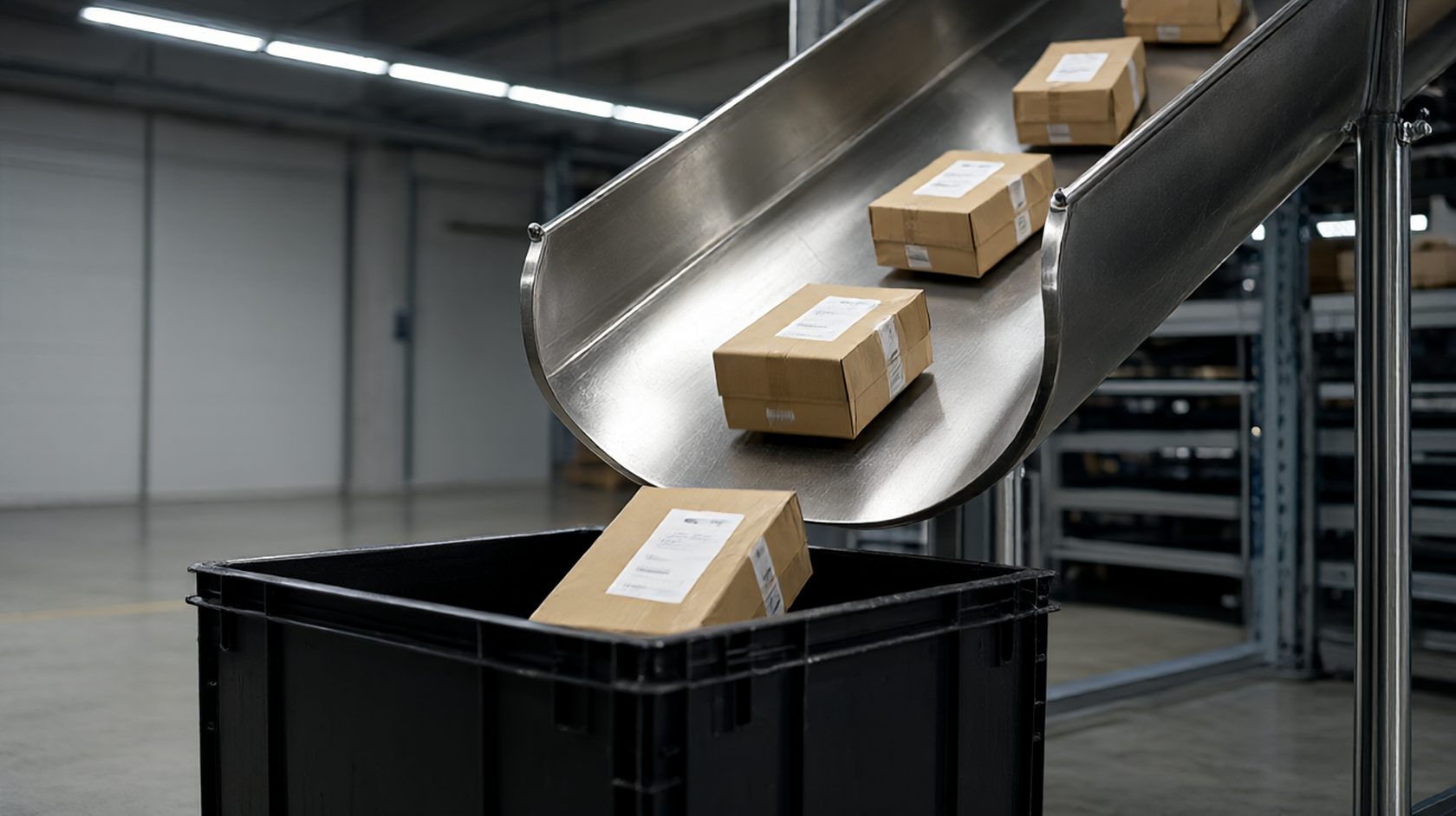
01The chute is a brake, not a slide
A parcel arrives at the chute with lateral speed from the divert and forward speed from the line. The chute's job is to absorb both without damaging the parcel and without letting it bounce out.
A long, shallow chute absorbs the energy gently and needs floor space. A short, steep chute is compact and delivers the parcel at speed into the bag or the tote, which is where most damage happens.
The material matters as much as the angle. A stainless chute with a polished surface lets a polybag slide; the same chute with a rough surface holds the bag and the next parcel lands on top of it.
02Throat geometry and the arriving parcel
The throat is the opening the parcel must enter, and its width is set by the largest parcel plus tolerance for the arriving angle.
A parcel arriving 15 degrees off square needs a throat roughly 1.4 times the parcel width. Too many chutes are drawn to the parcel's nominal width and then blamed for the sorter's accuracy.
The throat's height matters too: a parcel that enters the chute and stands up will jam the next one. A vertical lip at the entry is a cheap way to keep the parcel lying down.
03Recirculation: the number that explains a shortfall
Recirculation is the percentage of parcels that do not discharge correctly and come back for a second pass. It is the single most useful number in a sorter's operation, and it is rarely reported.
Two per cent is normal for a well-integrated line. Five per cent means one parcel in twenty is paying for the sorter twice, and the throughput figure the line promises is already wrong.
The causes are usually distribution: one or two chutes with bad geometry account for most of the recirculation, and the fix is a chute change rather than a sorter change.
04Fill-level logic and the chute that closes early
A chute has a capacity, and the control has to close it before it overflows. The question is where the threshold sits.
Too high and parcels bounce out of a full chute; too low and the chute is closed while it still has room, which pushes parcels to a second pass and inflates the recirculation rate.
The threshold is usually set by the bag or tote changeover time: a chute should close with enough time for the operator to change the container and be ready before the next parcel arrives.
05The commissioning test for chutes
Test every chute with the difficult parcel in the mix, not the average one. A polybag, a 600 mm carton and a 25 kg box will find the geometry problems that a standard test parcel hides.
Record the entry angle, the landing point and the exit speed for each chute. Three numbers per chute, and they are the baseline for every later complaint.
Re-test after any change to the sorter's divert speed. The chutes were designed around one entry condition, and a speed change invalidates that design without telling anyone.
06Materials, friction and the bag that will not slide
Chute surfaces are chosen for friction, and the friction a polybag presents is not the friction a carton presents. A polished stainless chute that lets a carton run will hold a bag in place until the next parcel lands on it.
The usual compromise is a chute with a textured or coated surface that gives a bag something to grip and still lets a carton slide. The coating wears, and the wear shows first where the parcels land.
The angle has to be set for the least-sliding parcel, which means the chute is steeper than a carton needs. The steeper angle is what damages the parcel at the bottom, and the damage is the price of handling bags.
A chute that cannot be made steep enough needs a different answer: a short powered section, or a bag stand that presents the bag at the chute's exit rather than under it.
07Bag stands and tote interfaces
The chute's exit is where the parcel meets its container. A bag stand that holds the bag open at the right height is the difference between a parcel that lands and a parcel that bounces out.
The stand's height is set by the chute's exit geometry, and its position is set by the operator's reach. A stand that is ten centimetres too low makes every parcel a lift.
Tote interfaces have the same problem in a different shape: a tote that is not aligned with the chute's centre line catches the parcel on its rim, and the rim is where the labels get torn.
The interface is usually built on site by the integrator's team, and it is usually the least engineered part of the line. It is also where most of the manual handling complaints originate.
08A chute audit every quarter
Chutes change. Operators add a bag stand, a guard or a sign, and the geometry that was tested at commissioning is not the geometry in service.
A quarterly audit records the entry angle, the throat width, the exit height and the container interface for every chute. Four photographs and a tape measure per chute is an hour's work for a forty-chute line.
The audit's value is in the comparison. A chute that has drifted from its commissioning numbers is a chute that will show up in the recirculation report three months later.
The audit also catches the chutes that were never right. A line commissioned in a hurry will have two or three chutes that never performed, and the audit is the moment to fix them rather than explain them.
09The chute that was never right
On almost every line there is one chute that has recirculated since commissioning. Its throat is a few centimetres narrow, or its angle is two degrees shallow, and it has been explained away as the sorter's tolerance ever since.
The identification is simple: run the recirculation report by chute for one week. If one chute accounts for a third of the returns, it is a chute problem and the sorter is innocent.
The fix is usually physical: widen the throat, change the entry lip, or add a deflector. All three are cheap compared with the parcels that chute has been sending round for a year.
The lesson is that a chute is a designed component, not an accessory. Lines that treat chutes as accessories spend their maintenance budget on recirculation.
10The chute's contribution to the pick rate
The chute is where the parcel leaves the automated line and meets a person. Its design decides how long that person takes, and the person is usually the rate constraint at the end of the line.
A chute that delivers the parcel at waist height, in the right orientation for the bag, saves two seconds per parcel against a chute that delivers it at knee height and rotated.
Two seconds per parcel at six hundred parcels an hour is twenty minutes an hour, which is a third of a picker's shift paid for by chute geometry.
The measurement is a stopwatch and a sample of fifty parcels per chute. It is the cheapest improvement available on most lines and the least often done.
11The two chutes that decide the line's reputation
Every sorter line has two or three chutes that account for most of the complaints. They are the chutes where parcels arrive damaged, where bags tear, and where the recirculation report points.
Operators learn to avoid them. A chute that is avoided is a chute that is effectively closed, and the line's capacity is reduced by the avoidance rather than by the design.
The fix is usually a day's work with a fabricator: a new entry lip, a wider throat, a softer exit. It is the highest-return maintenance job on most lines and the one most often deferred because the line keeps running.
A line that runs with a bad chute is a line that has accepted a permanent tax on its own capacity. Someone should be able to name that tax in parcels per hour.
Where the recirculation rate is dominated by chute geometry, the put wall with a wider chute throat is the unit whose throat is drawn for the arriving angle rather than the nominal parcel width.
What to check
- Chute angle and length against the parcel's arrival energy
- Throat width 1.3 to 1.5 times the largest parcel width
- Recirculation measured per chute during the acceptance week
- Fill threshold set from the container changeover time